
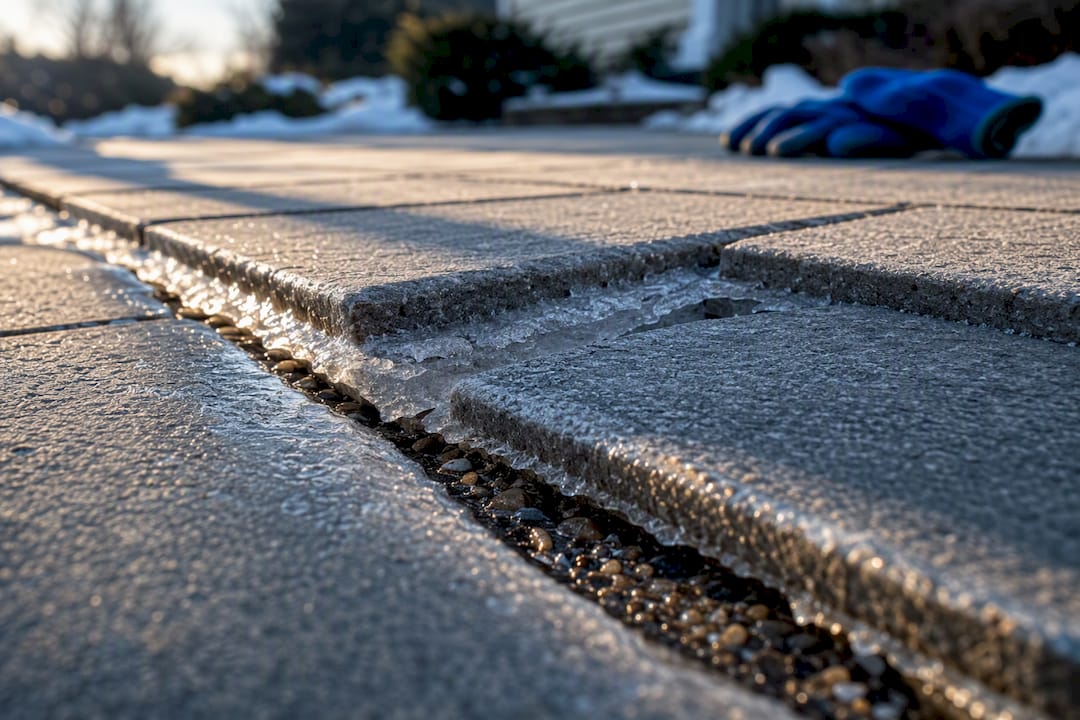
Yes, repeated freeze-thaw cycles will damage a paver installation when water gets trapped in the joints or base. The single most effective defense is a free-draining, non-frost-susceptible base paired with joints that drain instead of hold water. Get that right and many of the cracking, heaving, and surface flaking homeowners dread becomes far less likely.
TL;DR:
- Using a free-draining, non-frost-susceptible base with minimal fines is essential to prevent water trapping and reduce damage from freeze-thaw cycles.
- Signs of freeze-thaw damage include uneven settling, surface spalling, cracks, and erosion of joints, which require different repair approaches based on severity.
- Proper installation details such as adequate compaction, deep edge restraints, and correct jointing significantly improve a paver system’s winter resilience.
- Avoid harsh de-icing salts and promptly remove meltwater to minimize frost heave and surface deterioration during winter.
- A saturated or poorly graded base is the root cause of recurring damage, making water control and proper base design the highest priorities in prevention.
Table of Contents
- How freeze-thaw cycles damage pavers
- Signs to watch for on your patio or driveway
- Why base, drainage, and installation quality matter
- Prevention and winter care that actually work
- Repair options from small fixes to full rebuilds
- Pro installation checklist for freeze-thaw resilience
- Damian’s take: water control beats every other fix
- Sources
- FAQ
How freeze-thaw cycles damage pavers
When that water is sitting in a paver base or joint, the expansion pushes against the surrounding material with enough force to crack concrete, shift stone, and lift entire sections of a walkway or patio. Repeated freezing and thawing forms ice lenses within the soil, a process that draws more moisture upward and produces frost heave over the course of a winter. A peer-reviewed engineering review describes this as a mix of hydrostatic pressure, osmotic effects, and salt crystallization acting on the material at a microscopic level, and notes that deicing salts speed up the damage when combined with vehicle or foot traffic.
The visible results show up as a handful of distinct failure modes:
- Surface scaling or spalling: thin flakes or chips break off the paver face.
- Cracking: stress cracks form across the unit, sometimes following a pattern engineers call D-cracking in poor-quality concrete.
- Settlement or heave: sections sink or rise unevenly as the base shifts.
- Joint erosion: sand washes out between units, leaving gaps that let in more water.
Deicing salts make a bad situation worse. Engineering research links salt exposure combined with freeze-thaw cycling to a measurable acceleration in surface deterioration, which is one reason paver manufacturers test for salt resistance separately from plain freeze-thaw resistance.
Signs to watch for on your patio or driveway
Some damage is cosmetic and some is a safety issue. Here’s how to sort one from the other:
- Hairline cracks across a single paver usually mean you can monitor the area and plan a repair.
- Spalling or flaking surfaces signal the paver material is breaking down and should be replaced soon.
- White, powdery efflorescence is mostly cosmetic and often fades with normal weathering.
- Sunken or rocking pavers create a trip hazard and warrant prompt attention.
- Recurring pooling water after rain or snowmelt points to a drainage problem in the base, not just the surface.
- Sand washout between joints invites more water into the base and should be refilled before winter.
- Uneven surfaces near steps or doorways are urgent: stop using that area and call a professional to assess the base.
Why base, drainage, and installation quality matter
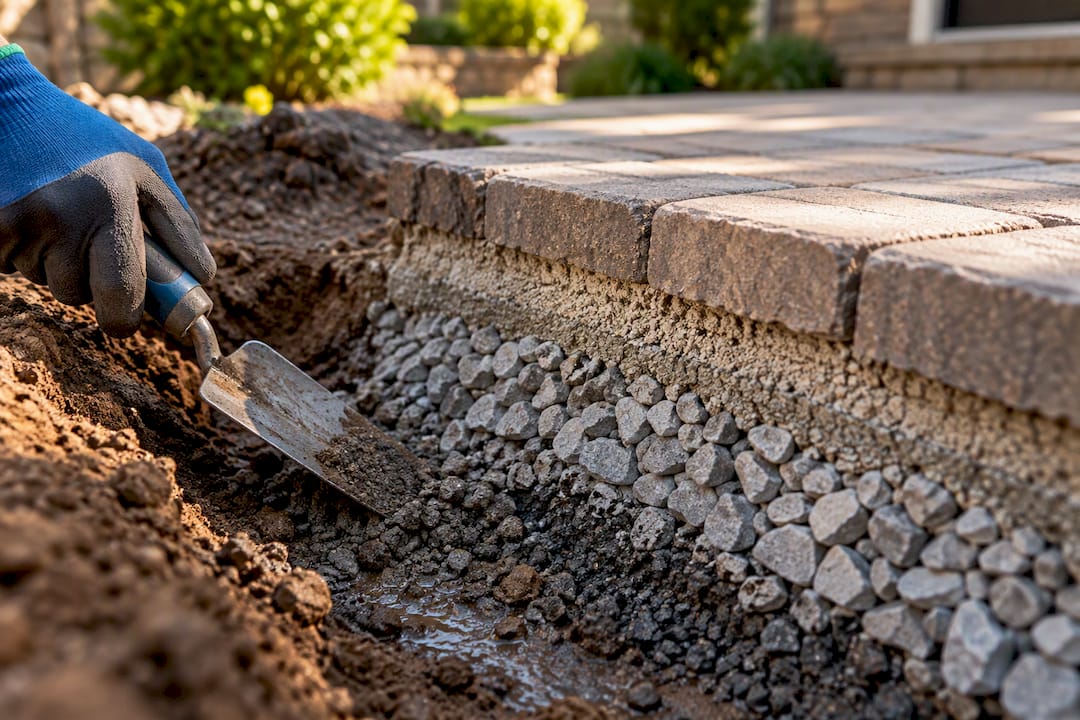
Most freeze-thaw failures trace back to what’s under the pavers, not the pavers themselves. FHWA geotechnical guidance identifies a free-draining, non-frost-susceptible base as the most effective long-term defense against frost action, built with well-graded aggregate that keeps fine particles, the material that passes a No. 200 sieve, to a minimum. Fines hold water like a sponge, and that trapped moisture is exactly what forms ice lenses. Our explanation of patio base design covers how the right aggregate profile keeps water moving instead of sitting still.
Material selection matters too. ASTM C936 requires concrete interlocking paving units exposed to deicing salts to demonstrate freeze-thaw resistance through mass-loss testing, so units intended for cold, salted surfaces should carry documented test results or a track record of field performance.
Beyond the base and the units themselves, a few installation details protect the whole system:
- Proper compaction at every lift prevents voids where water can collect.
- Edge restraints keep the paver field from spreading and opening gaps at the perimeter.
- Correct jointing locks units together and slows sand washout during heavy rain or snowmelt.
Pro Tip: Ask any contractor bidding on your project what percentage of fines their base aggregate contains: a number near zero is what you want to hear.
Prevention and winter care that actually work
Prevention starts at design and continues every winter after that. In order of impact:
- Choose a free-draining base and good edge restraint before anything else. A permeable paver system with an open-graded aggregate base lets meltwater pass through rather than pool on the surface.
- Keep joints full. Polymeric sand locks in place and resists washout better than plain sand, though it needs proper activation and can be harder to remove if you ever reset a paver.
- Clear surface drains and downspouts before the ground freezes so meltwater has somewhere to go.
- Reseal joints and surfaces on a normal maintenance schedule if your installer recommends it for your material.
For winter operations specifically:
- Use a plastic shovel or a plow with a rubber edge to avoid scratching or chipping paver faces.
- Skip rock salt where you can. Low-chloride ice-melt products are gentler on masonry surfaces, and homeowner guidance on freeze-thaw cracking specifically recommends avoiding harsh de-icing salts near hardscaping.
- Remove melted ice residue promptly instead of letting it refreeze in joints overnight.
- Keep heavy plow blades away from paver edges, where the impact risk is highest.
Permeable systems aren’t a universal fix. They work well where surface water control is a real problem, but they still need the right base and regular maintenance to keep performing.
Repair options from small fixes to full rebuilds
Not every crack means starting over. The same homeowner guidance on freeze-thaw damage recommends matching the repair to the scale of the problem:
- Small repairs: re-sand the joints, swap out one or two damaged pavers, and use a flexible joint sealant rather than rigid epoxy in areas that shift with temperature.
- Intermediate repairs: for localized sinking, a contractor lifts the affected pavers, adds fresh bedding sand, re-compacts the area, and resets the units level.
- Major repairs: recurring frost heave or a saturated base usually means the base itself has failed and needs to come out. A full rebuild lets a contractor correct the grading, install a properly graded aggregate base, and restore edge restraints before pavers go back down.
If you’re seeing the same problem return year after year in the same spot, that’s the clearest sign the base needs attention, not just the surface. Our hardscape services overview covers what a professional repair or rebuild typically involves.
Pro installation checklist for freeze-thaw resilience
When we build or inspect a permeable paver patio, seven checks make the biggest difference in how the surface holds up through winter:
- Confirm the base profile depth matches the region’s frost line.
- Use open-graded aggregate with minimal fines throughout the base.
- Compact each lift to spec, not just the final surface.
- Install edge restraints deep enough to resist frost movement.
- Choose jointing material suited to the paver type and expected traffic.
- Check surface tolerances for flatness and consistent slope.
- Run a final compaction and drainage test before calling the job complete.
For porcelain pavers specifically, correct installation on an appropriate base with mechanical edge restraints can support 15 to 20 years of service, and installers check flatness tolerances closely since porcelain doesn’t forgive an uneven base the way some other materials do. Our porcelain paver guide covers what to ask an installer before signing a contract.
Pro Tip: Ask to see compaction test results before the pavers go down, not after. It’s the one step you can’t verify once the surface is finished.
Damian’s take: water control beats every other fix
Spend the extra time and money on base drainage up front. Every recurring paver problem I’ve seen traces back to water that had nowhere to go, and no amount of joint sand fixes a bad base. If a contractor can’t explain their drainage plan clearly, that’s your answer on whether to hire them.
— Damian
Sources
- NHI-05-037 – Chapter 7 – Geotechnical guidance (FHWA)
- Impact of Freeze–Thaw Cycles on the Long-Term Performance of Concrete Pavement and Related Improvement Measures: A Review
- What to Do If Freeze-and-Thaw Cycles Cracked Your Hardscaping (The Spruce)
FAQ
Will paver efflorescence go away?
Efflorescence, the white powdery residue on paver surfaces, is mostly cosmetic and often fades on its own with normal weathering and rain. It’s a sign of mineral deposits rising to the surface, not a sign of structural freeze-thaw damage.
Will concrete settle after frost heave?
Concrete and paver surfaces can settle unevenly once frost heave has lifted and dropped sections of the base repeatedly over multiple winters. When settlement recurs in the same spot each year, it typically points to a saturated or poorly graded base that needs to be rebuilt rather than patched.
What is the downside to polymeric sand?
Polymeric sand resists washout better than plain sand, but it needs correct activation with water and can be difficult to remove cleanly if you ever need to lift and reset a paver. It also performs poorly if applied incorrectly or in wet conditions.
What does freeze-thaw do to concrete?
Freeze-thaw cycling drives water into small pores and cracks in concrete, where repeated freezing expands the trapped moisture and gradually breaks the material apart. Engineering research identifies this cycle, worsened by deicing salts, as a major factor limiting the service life of concrete pavement and paver installations.