
The best patio privacy comes from matching the solution to the line of sight you want to block. In New Hampshire it also has to survive snow load, wind and a long dormant season. The ideas below cover privacy screens, plants, pergolas and fences. For each one you’ll see where it works, where it falls short and what to check before you commit.
TL;DR
- Find the specific sightline first. A neighbor’s second-story window needs overhead or tall screening, not a standard fence.
- Mix evergreens with structure (a screen, pergola or wall) so you don’t lose privacy from late fall to spring.
- Side and rear fences commonly top out at 6 feet and front-yard fences at 4 feet, but your town’s rules decide. Call the building department before you buy materials.
- Choose materials rated for wind and snow. Light fabric screens that work in other regions can fail in a New England gust.
- A designed combination of hardscape and plantings usually beats any single fix.
Table of Contents
- Start With the Sightline, Not the Product
- Privacy Screens for a Patio
- Patio Privacy Plants That Work Here
- Privacy Pergola Ideas
- Fences and What Your Town Allows
- Privacy for Side Yards, Small Patios and Front Entries
- Design for Four Seasons
- Our Perspective: Combine Structure and Plantings
- Planning a Private Patio With Us
- A Simple Way to Decide
- FAQ
- Sources
Start With the Sightline, Not the Product
Most people shop for a product, such as a screen, a hedge or a fence, before they know what they are blocking. That’s backward. Garden designers advise evaluating the space and the specific challenge first, such as a neighbor’s second-story window looking down into the yard or foot traffic from the street.
The reason is simple geometry. A 6-foot fence does nothing against a window that sits 15 feet up. Overhead cover, a tall tree set closer to the viewer, or a pergola with a roof or slats solves that problem. A fence solves a ground-level one.
Before you pick anything, do this on a clear day:
- Sit where you actually sit on the patio, in your usual chair.
- Note every spot someone could see you from: windows, driveways, the street, a neighbor’s deck.
- Mark each one as ground level or elevated.
- Note the time of day. Low afternoon sun and winter light change both the views and the shade.
- Decide how complete you want the privacy. A partial screen that frames a seating area often feels better than a wall.
That short list tells you whether you need height, overhead cover, or just a few well-placed panels.
Privacy Screens for a Patio
Privacy screens are the fastest route to a private patio, which is probably why people search for them far more than for any other option. They come in several types.
Freestanding slat or louver screens
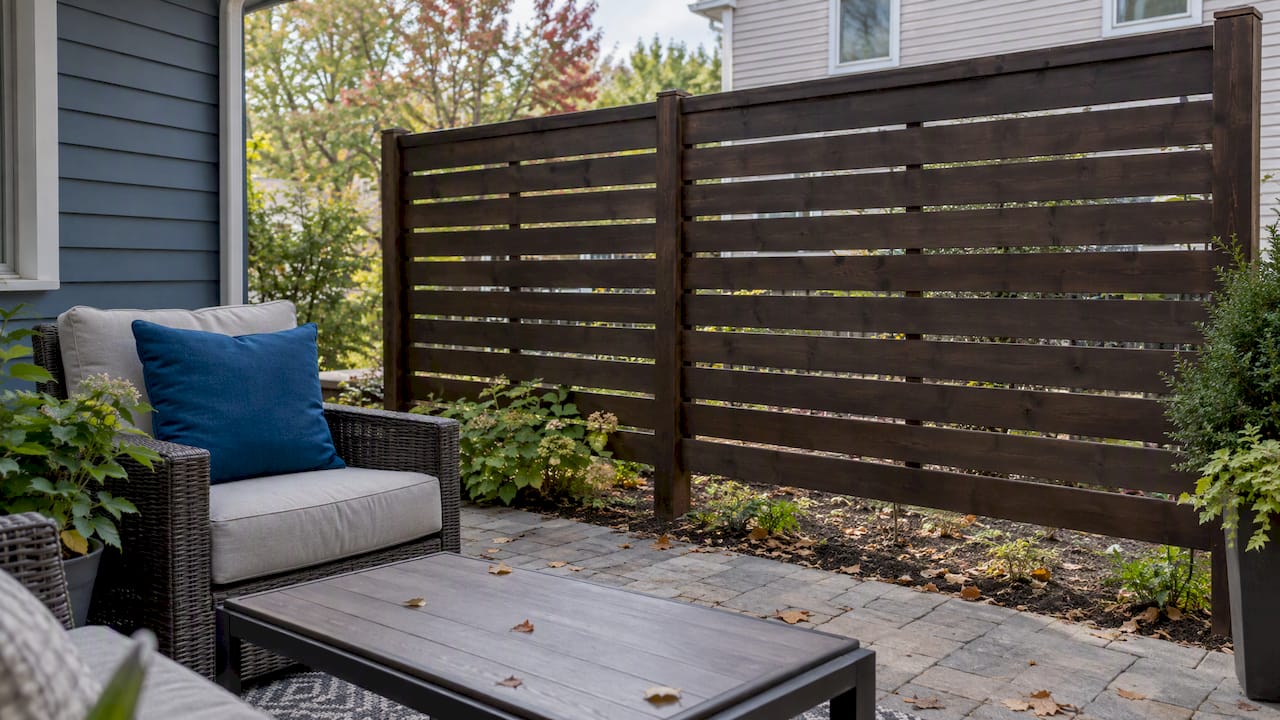
Wood, composite or aluminum slat panels set on posts or a base. They give you privacy exactly where you want it and can be placed along one side of the seating area. Spacing the slats slightly apart lets air through, which reduces wind load and keeps the patio from feeling boxed in.
Masonry and stone walls
A low seat wall with a taller section, or a full privacy wall, is permanent and quiet. It blocks noise better than most alternatives. It does need a proper base and drainage behind it, which is why it is a job for a hardscape contractor, not a weekend project. Walls can also double as seating, planters or a backdrop for a firepit.
Retractable and zip screens
If you want privacy only when you’re using the space, motorized screens are an option. One manufacturer states certain models are rated for wind up to 130 mph and drops of up to 20 feet are possible. They are best on a covered patio or pergola with a solid mounting point. Check the rating for the exact model you are considering, because the range between products is wide.
Outdoor curtains, shade sails and fabric
Outdoor drapery panels and shade sails are inexpensive and softer in look. In New Hampshire they work best as a seasonal layer, from late spring to early fall. Wind is the weak point, so plan on taking them down before the first big storm. Standard fabric screens made for lighter climates may not last through typical gusts, so ask about the wind rating.
Planter-based screens
Tall, narrow planters with a trellis or evergreen shrubs give you privacy that moves. This suits patios that sit close to a house wall or have little room for in-ground plantings. Use containers large enough to insulate roots, and expect to protect or replace plants in zone 5 winters.
Patio Privacy Plants That Work Here
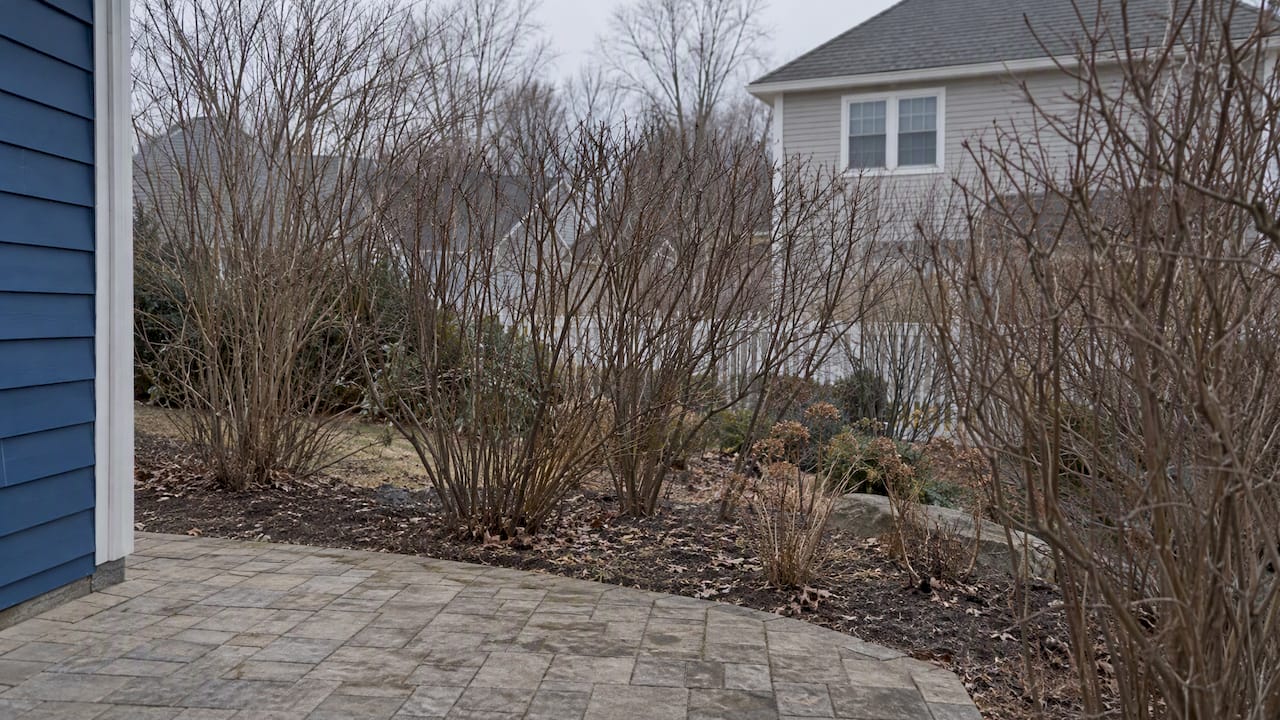
Plants give you the most natural result, and they improve with age. They also have a built-in limit: a screen made only of deciduous plants leaves a privacy gap from late autumn through spring. If you use your patio from May to October, that may be fine. If you want views from the kitchen window blocked in January, it isn’t.
Evergreens for the backbone
Native or well-adapted evergreens hold their shape and density through frost. Eastern red cedar and arborvitae are the common picks, and both are suited to wind and visual screening. Some arborvitae, such as ‘Green Giant’, can reach about 60 feet, so match the variety to the space. Narrower varieties suit a tight side yard. University of Maine Cooperative Extension also notes that pyramidal junipers can fill in to form a wall-like hedge.
Don’t plant one species only
A row of identical shrubs looks tidy, but one pest or disease can take out the whole row. Extension horticulturists recommend mixed privacy screens for resilience. Combine two or three evergreens with a flowering shrub or ornamental grass in front. The mix also looks better, and it makes the planting easier to repair if one plant fails.
Layer the planting
- Back layer: tall evergreens, set far enough from the patio that mature branches don’t crowd it.
- Middle layer: shrubs 6 to 8 feet tall, which handle the eye-level view.
- Front layer: perennials and grasses that give color and soften the edge.
Plants take time. A young hedge may need three to five seasons to close up, so many homeowners pair a structure for immediate privacy with plantings that mature behind or beside it.
Privacy Pergola Ideas
A pergola is the answer when the problem is above you. It also gives the patio a defined “room,” which makes people feel more private even before anything is added.
- Slatted or louvered roof: blocks views from upper windows and gives shade. Closely spaced rafters do more than wide ones.
- Side panels or lattice on one or two sides: put them on the side facing the neighbor and leave the rest open for airflow and views.
- Climbing vines on the posts: soften the structure and add leaf cover in summer. Pick vines suited to your zone, and plan on pruning.
- Removable or roll-up side panels: a pergola with removable side panels lets you close in the space as temperatures drop and open it up again in summer.
- Pavilion or gazebo: a full roof and solid or screened sides provide the most enclosure, and they extend the season.
Structure matters here. If you add a solid wall or heavy panels, the frame has to be built for local snow loads, not just for looks. Some commercial-grade privacy wall systems list snow load ratings up to 100 lb per square foot, which gives you a sense of the numbers engineers work with. Whatever you choose, ask your contractor how the design handles snow and wind.
Fences and What Your Town Allows
A fence is the classic solution, and it is often the right one for a ground-level sightline. Rules vary by town, so check before you plan.
In New Hampshire, zoning is local. Front-yard fences are commonly limited to 4 feet, and side and rear fences are commonly capped at 6 feet, as seen in towns like Windham. Many towns also require the finished side of the fence to face the neighbor. Fences near driveways and intersections have to meet clear sight triangle requirements, which is a common reason permits get denied.
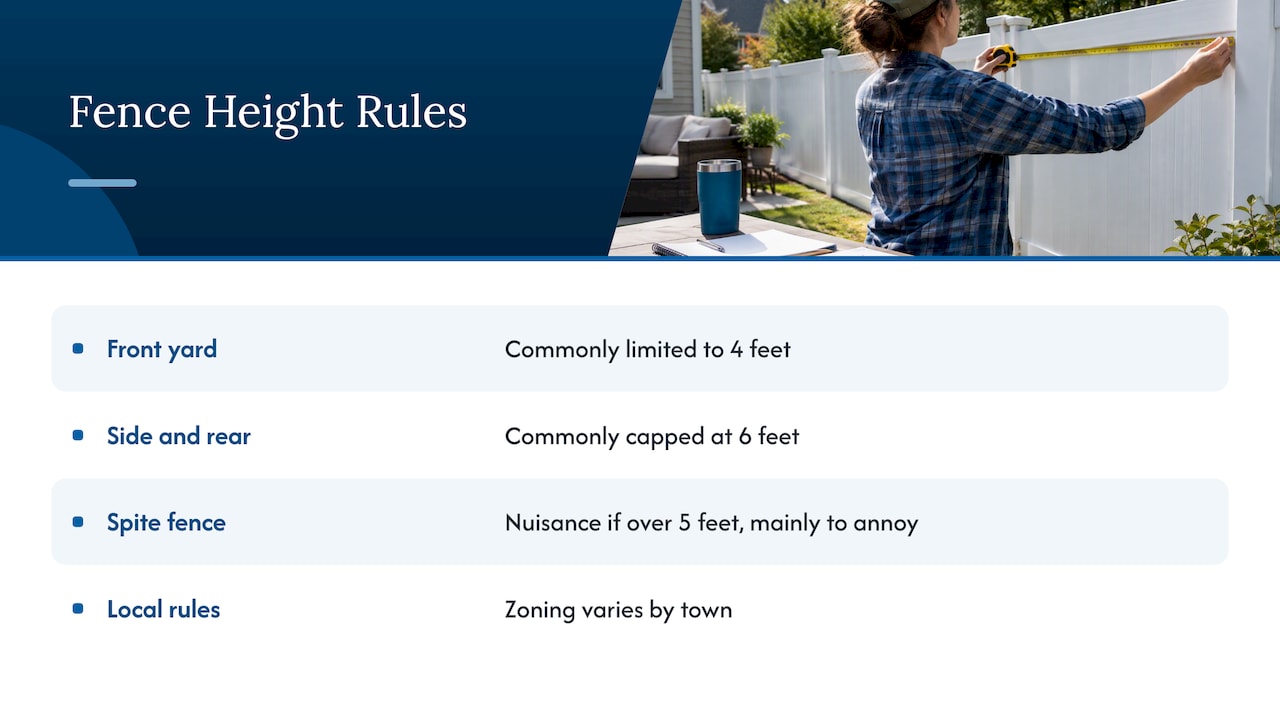
One more state-level point: a spite fence law treats a fence over 5 feet built mainly to annoy a neighbor as a private nuisance. A fence built for your own privacy is a different matter, but it’s one more reason to talk to the neighbors first.
The practical advice is the same everywhere: call your town’s building or land use department before buying materials, and bring a rough sketch with heights and distances from the property line.
When a fence is not the best answer
A full fence can feel closed in and may not be allowed at the height you need. It does nothing for an elevated view. If you are asking what to use for privacy instead of a fence, the better answers are a mix of a short wall or screen panel near the seating area with evergreens beyond it, or a pergola with slatted sides.
Privacy for Side Yards, Small Patios and Front Entries
Different spaces call for different solutions.
| Space | Main challenge | Good approach |
|---|---|---|
| Side yard | Narrow, close to the neighbor | Slim evergreens or a slatted screen, plus lighting to make the path usable |
| Small rear patio | Overlooked from several directions | A pergola with one solid side, container plantings and a layered border |
| Patio facing the street | Foot and car traffic | Low wall with planting on top, plus hedge or shrub bed along the edge |
| Covered patio or porch | Side views under the roof line | Retractable screens, lattice panels or outdoor curtains |
| Overlooked by upper windows | Elevated sightline | Pergola roof, awning, or a tall tree set close enough to intercept the view |
The Real Homes roundup of patio privacy ideas also points to screens, pergolas and hanging plants as common ways to shelter a space from nosy neighbors.
Design for Four Seasons
Summer privacy is easy. The test is February. A design that holds up through the year has a few things in common:
- Evergreen structure so the screen doesn’t vanish in winter.
- Wind protection. A solid or partly solid screen on the windward side makes the patio usable on more days in spring and fall.
- Snow-load tolerance for any roof, pergola or heavy panel.
- Winter interest, such as bark, berries, grasses and lighting, so the view from inside is pleasant when the patio is closed.
- Drainage and grade that keep meltwater away from walls and posts. Our guide to patio drainage fixes covers this in more detail.
Professional landscapers in the state describe this as four-season functionality, and it’s the standard we design to.
Our Perspective: Combine Structure and Plantings
We design and build outdoor spaces for homeowners and business owners across New Hampshire, and the privacy projects that satisfy people longest follow a pattern.
First, we walk the property and look at it from where you will sit. Most privacy problems turn out to be one or two sightlines, not the whole yard. Solving those precisely costs less than enclosing everything.
Second, we pair something solid with something living. A stone or masonry wall, a custom pergola or a deck-side screen gives you privacy on day one. Evergreen and mixed plantings soften it and fill in over the following seasons. Neither alone does the whole job.
Third, we plan the details people forget: grade, drainage, footings, irrigation for the new plantings and lighting that makes the space feel like a room after dark. Those details are what separate a patio that looks good in July from one that still works in January.
If you already have a patio and it feels exposed, you often don’t need to rebuild it. A well-placed wall section, a pergola over part of the seating or a layered planting can change how the space feels.
— Damian
Planning a Private Patio With Us
If you want privacy designed into your patio rather than added afterward, our team can plan and build it as one project. Landscape design covers the sightline review, plant selection and layout. Patio installation handles the surface, base and drainage. Our decks and outdoor living work includes pergolas and gazebos, and our masonry and hardscape team builds walls, firepits and outdoor kitchens. Browse our project gallery for examples, or contact us to start with a consultation.
For more reading, see our guides on backyard privacy landscaping and privacy screening landscaping, and our look at patio design styles for New Hampshire homes.
A Simple Way to Decide
Use this order when you plan:
- Name the sightline (ground level or elevated, street or neighbor).
- Check town rules for fence height, setbacks and permits.
- Pick the structure: wall, screen, fence or pergola.
- Add evergreens first, then mix in other species for resilience.
- Test for winter: wind, snow load, drainage and what the view looks like from indoors.
- Phase it if the budget is tight. Build the structure first and let plantings mature behind it.
FAQ
What can I put on my patio for privacy?
The most common choices are freestanding screens, tall planters with evergreens, outdoor curtains, a pergola with slatted sides, and a short wall or fence. Pick based on whether the view you want to block is at ground level or from above. For year-round privacy in New Hampshire, combine a solid element with evergreen plantings.
What can I use for privacy instead of a fence?
A row of mixed evergreens, a masonry wall, a slatted screen near the seating area or a pergola with side panels all work. Plants take time to fill in, so many homeowners use a screen for immediate cover. This approach can also be easier to fit within local height limits.
How do I make a side yard private?
Narrow side yards suit slim evergreens such as upright arborvitae or a slatted screen that does not take much depth. Lighting along the path helps the space feel intentional. Check setbacks first, since your town may restrict structures close to the property line.
Do I need a permit for a privacy fence in New Hampshire?
It depends on your town. Many towns don’t require a building permit for residential fences of 6 feet or less, but height limits, setbacks and sight triangles still apply. Confirm with your town’s building or land use department before you buy materials.
Sources
- Garden Design: Privacy Landscaping
- Cultivating Flora: Extending Outdoor Living in New Hampshire Into Fall
- University of Maine Cooperative Extension: Evergreen Privacy Hedge
- University of Maryland Extension: Plants for Mixed Privacy Screens
- Town of Windham, NH
- Windham, NH Fence Permit Application
- PermitsGuide: New Hampshire Fence Permits
- Renson Fixscreen
- ARCAT: Operable Privacy Wall Specifications
- Real Homes: Patio Privacy Ideas