
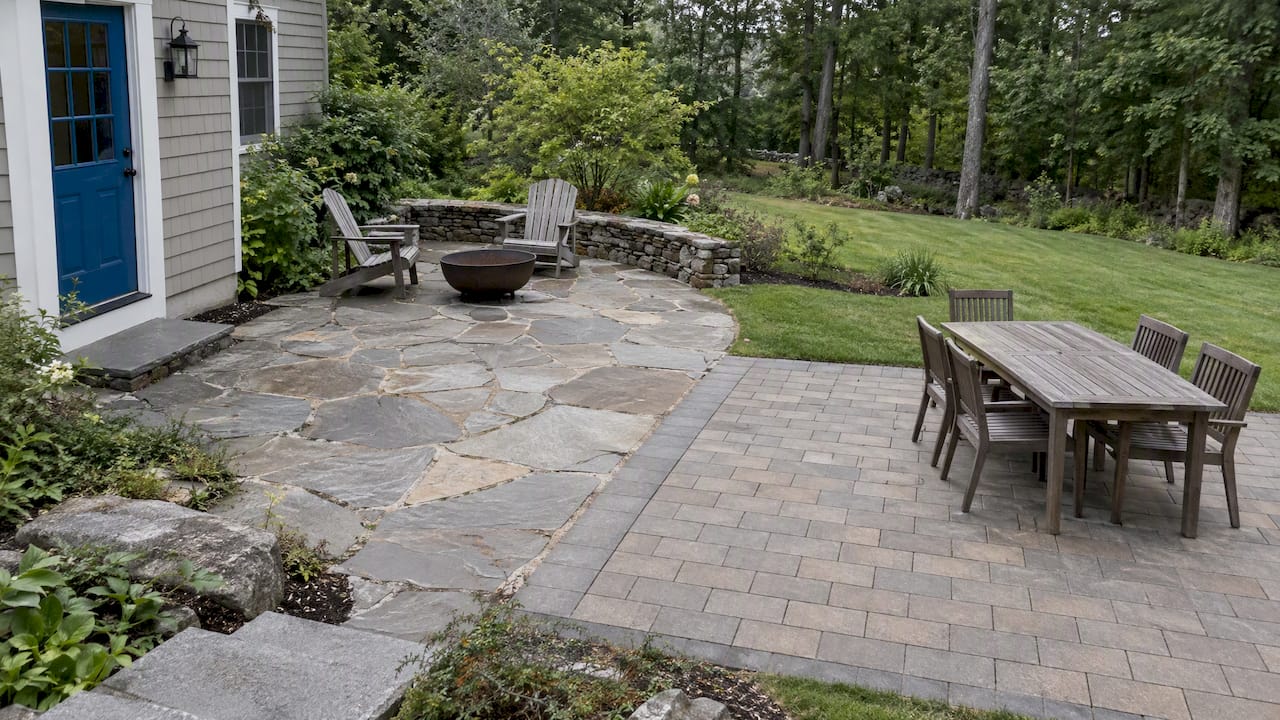
Choose concrete pavers if you want a predictable layout, a lower installed cost and repairs that mean lifting out a single unit. Choose flagstone if you want a one-of-a-kind natural surface and the budget for more labor. Both can handle New Hampshire winters when the base and drainage are built correctly, and that base matters more than the surface you pick.
Below, we compare the two on look, cost, freeze-thaw performance, repairs, maintenance and fit, so you can decide before you request bids.
TL;DR
- Pavers usually cost less installed and go in faster. Flagstone costs more because the stone is quarried and each piece is fitted by hand.
- Flagstone gives a natural, never-repeating look. Pavers give consistent shapes, colors and pattern choices.
- In New Hampshire, the compacted base and drainage decide how well either one survives frost, not the surface alone.
- Pavers are easier to repair. Mortared flagstone repairs are more labor-intensive.
- Sealing is optional for both. Sweeping, joint care and clearing drainage are the habits that matter.
Table of Contents
- What is the difference between flagstone and pavers?
- Cost: what a 20×20 patio can run
- Look and feel
- Freeze-thaw, drainage and the base
- Repairs: where the two differ most
- Maintenance and sealing
- Pros and cons at a glance
- When each material makes sense
- Our perspective
- Plan your patio with our team
- FAQ
- Sources
What is the difference between flagstone and pavers?
Flagstone is a broad category of flat natural stone used for paving. The Washington chapter of the American Society of Landscape Architects describes it as stones that may be random-shaped or cut to dimensions, and set in sand or in mortar. Common types in the Northeast include bluestone, granite and slate.
Concrete pavers are manufactured. They come in specific shapes, sizes and colors, and they are made to a consistent thickness. That consistency is what makes them quicker to lay and easier to replace.
So the real choice is natural authenticity against manufactured predictability. Neither is better in every yard. The right one depends on your budget, your site and how you plan to use the space.
Cost: what a 20×20 patio can run
Cost is the first question most homeowners ask, and a 20 by 20 foot patio (400 square feet) is a handy yardstick. Fixr’s patio cost guide, published in 2022, lists installed pavers at $10 to $25 per square foot and flagstone at $16 to $30 per square foot. Multiplied out for 400 square feet, that is roughly:
| Material | Installed range per sq. ft. | Rough range for 20×20 (400 sq. ft.) |
|---|---|---|
| Concrete pavers | $10 to $25 | $4,000 to $10,000 |
| Flagstone | $16 to $30 | $6,400 to $12,000 |
These are national figures from a 2022 guide, so treat them as a starting frame. Prices in our area have moved since then, and your own quote will reflect your site. We do not publish fixed prices, because the same patio can price very differently depending on what is under it.
Flagstone generally lands higher for one reason: labor. Irregular pieces must be sorted, fitted and set one by one, while pavers follow a repeatable pattern.
What moves the price on either material
- Site access. A tight side yard that forces hand carrying costs more than a driveway that a skid steer can reach.
- Grade and drainage. A sloped lot may need grading, a retaining wall or a drain before any surface goes down.
- Base depth. Frost-prone ground calls for a deeper, well-compacted base.
- Pattern and edging. Curves, borders and inlays add cutting time.
- Stone type. Dense bluestone and granite cost more than softer or thinner stone.
- Add-ons. Steps, seat walls, firepits and lighting all add to the total.
For a wider look at surfaces, see our guide to the best patio materials for NH homes.
Look and feel
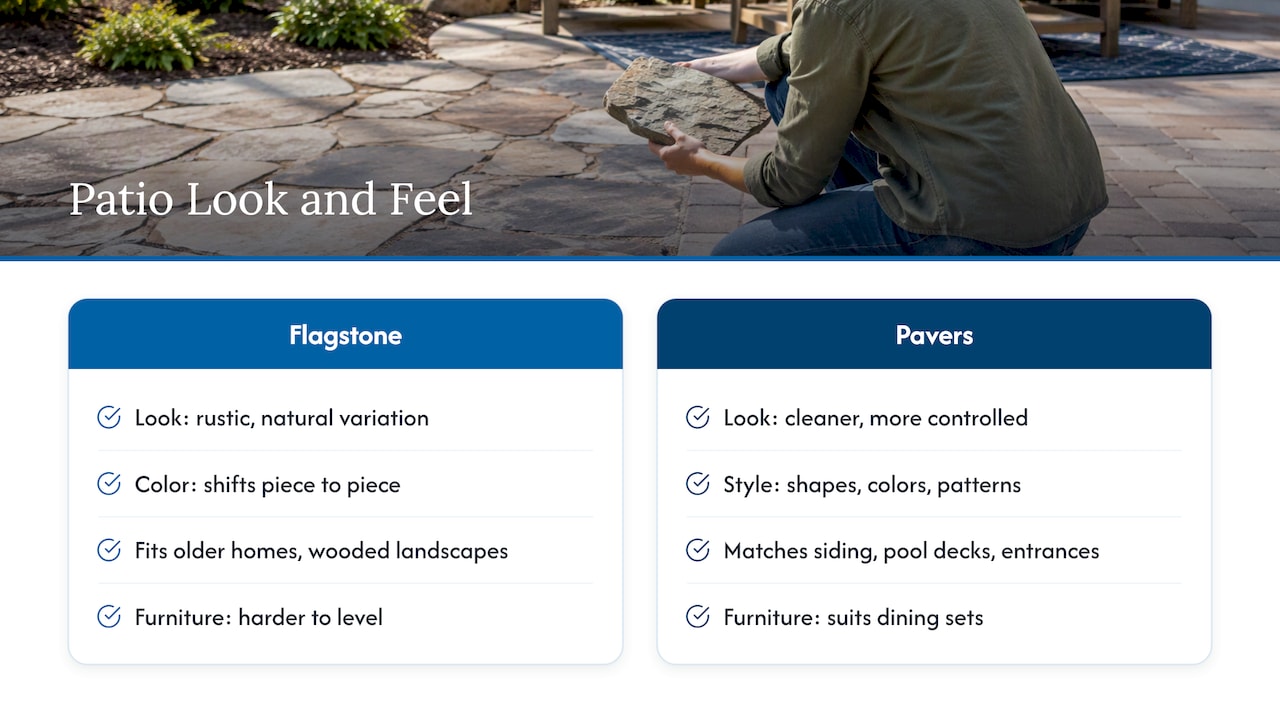
Flagstone has a natural, rustic character. No two stones match, and the color shifts from piece to piece. That variation is the appeal. It suits older New England homes, stone walls and wooded or informal landscapes.
Pavers offer a cleaner, more controlled look. You can choose from many shapes, colors and patterns, including running bond, herringbone and modern large-format layouts. That makes it easier to match a home’s siding, a pool deck or a commercial entrance.
One practical point: a flagstone surface can be uneven, since the stone has a natural cleft face. That can make it harder to level furniture. A flat-cut stone or a tighter joint spacing reduces the issue. Pavers sit flat by design, which suits dining sets and outdoor kitchens.
If you are leaning toward natural stone, our page on what a natural stone patio is walks through the options.
Freeze-thaw, drainage and the base
New Hampshire patios go through many freeze-thaw cycles each winter. Water gets into the ground and the joints, freezes, expands and heaves whatever sits on top. Most failed patios fail because of the base or the drainage, not because the surface was the wrong material.
How pavers hold up
Concrete pavers made to the ASTM C936 standard must reach an average compressive strength of at least 8,000 psi and average absorption of no more than 5%. Low absorption matters in cold climates because less water in the unit means less freeze damage. Ask your contractor which standard the pavers meet.
For a deeper look, read our checklist on freeze-thaw paver damage.
How flagstone holds up
Natural stone varies more. Dense, low-absorption stone such as bluestone or granite resists frost well, and a correctly specified natural stone can last for decades. A porous or thin stone does not. The stone type, thickness and how it is set (sand or mortar) decide the result. Mortared work needs a stable, properly built base, because a rigid surface over shifting ground cracks at the joints.
Base and drainage: the same rule for both
For pervious patios, the New Hampshire Department of Environmental Services recommends a minimum sub-base of 12 inches of 1½-inch washed stone topped with 6 inches of 3/8-inch pea stone, subject to the paver manufacturer’s instructions. The same document says pervious pavers work best on slopes under 2% and should only be built where soils drain within 24 hours, confirmed with an infiltration test.
Those figures apply to permeable designs specifically. A standard patio base is different, but the lesson carries over: a deep, compacted, free-draining base is what keeps a patio flat through winter. Our explainer on what a patio base is covers the layers, and our guide to fixing standing water on a patio covers what to do if water already collects.
Water and the rest of your yard
Stone and permeable pavers let more water soak in than asphalt or poured concrete. UNH Extension recommends minimizing impermeable surfaces and planning drainage to slow runoff. If you are considering a permeable patio, see our walkthrough of permeable paver installation steps. Planted areas around the patio help too, and the environmental benefits of lawn are worth weighing when you decide how much of the yard to pave.
Repairs: where the two differ most
This is where pavers earn their reputation. If a paver cracks or sinks, a contractor can lift the unit, correct the base underneath and set a new one. The patio looks the same afterward.
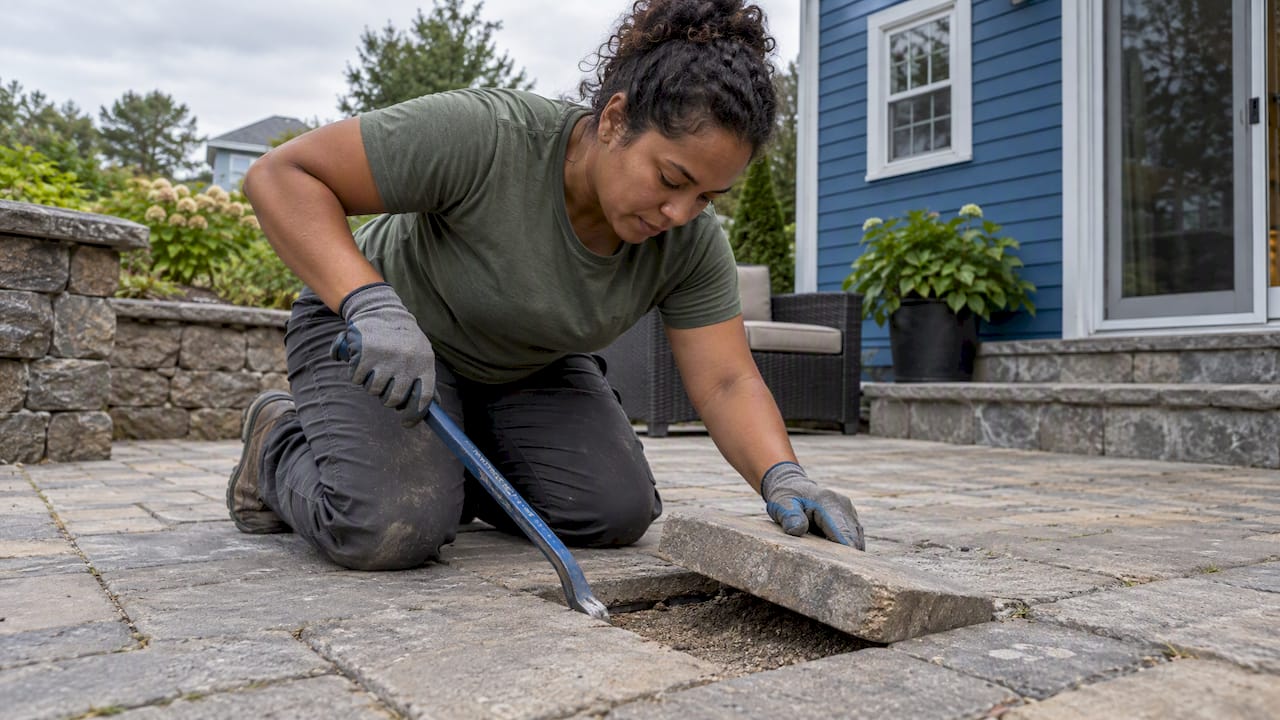
Mortared flagstone is harder. Damaged stones have to be chiseled out and the joints remortared, which takes more labor. Sand-set flagstone is more forgiving, since individual stones can be lifted and reset, but matching a natural stone later can be difficult because each piece is unique.
If you expect to open the ground later, for a utility line, irrigation or lighting, a sand-set paver patio is the easier surface to take apart and put back.
Maintenance and sealing
Both surfaces are low-maintenance, not no-maintenance.
Flagstone care
- Sweep regularly and wash periodically.
- Clean up spills such as oil, wine and grease promptly, especially on lighter or porous stone.
- Control weeds in the joints.
- Check that drainage stays clear.
- Sealing is optional. It depends on the stone, its finish and whether you want added protection from stains or help keeping color. A sealer may need reapplying every few years.
Paver care
- Sweep and wash as needed.
- Top up joint sand when it washes out. Polymeric sand can help the joints resist washout and weeds.
- Sealing is optional in many installations. A compatible sealer can help with staining and color fading, and it will need reapplying. Common surface sealers are often cited at roughly three to five years.
So, do pavers need to be sealed? Not always. Sealing makes sense when you have a fire feature or an outdoor kitchen that will see grease and drips, or when you want to keep color vivid. Our guide to when to seal pavers lists the signs to watch for.
Pros and cons at a glance
| Pavers | Flagstone | |
|---|---|---|
| Look | Uniform, many patterns and colors | Natural, varied, one of a kind |
| Installed cost | Generally lower | Generally higher |
| Installation | Faster, repeatable | Slower, each piece fitted |
| Repairs | Lift and replace single units | More labor, especially if mortared |
| Surface | Flat and consistent | Can be uneven, harder to level furniture |
| Frost performance | Look for ASTM C936 compliance | Depends heavily on stone type |
| Maintenance | Sweep, refill joint sand, optional sealer | Sweep, wash, weed joints, optional sealer |
When each material makes sense
Choose flagstone when:
- You want a distinctive natural character that fits a wooded, rustic or traditional New England property.
- A premium appearance justifies the higher installation cost.
- You are working with a properly built, stable base and a dense stone type.
Choose pavers when:
- You want a predictable layout and a wide choice of patterns.
- You want flexible dry-set construction and simple repairs.
- You plan an outdoor kitchen, a dining area or other spots where a flat surface matters.
- You want to control budget and schedule.
For commercial and heavily used areas, either can work when it is properly engineered. Repeatable pavers often make phasing and replacement simpler, and natural stone makes sense where design identity outweighs cost. For a multi-unit site, our multi-tenant property design guide covers the planning side.
You can also mix them. A paver field with a natural stone border, or flagstone steps leading to a paver terrace, gets the look of stone where you see it most and the simplicity of pavers where you live on the surface. Porcelain is a third option, covered in our page on porcelain pavers outdoors. For paths, see our guide to front walkway materials.
Our perspective
We build both, and we do not push one over the other. Our job is to match the surface to your property, your budget and how you plan to use the space.
What we have learned from 20+ years of combined hands-on experience is that homeowners spend most of their time comparing surfaces, while the work that decides how a patio ages happens below the surface. Excavation depth, base compaction, grade and drainage come first. When those are right, a paver patio and a flagstone patio can both stay flat and attractive through New Hampshire winters.
Our approach is custom design for each property, premium materials and clear project management from consultation through installation, backed by a satisfaction guarantee. If you tell us how you entertain, what the yard looks like and what you want to spend, we will show you where flagstone is worth it and where pavers give you more for the money.
Damian
Plan your patio with our team
Divine Landscaping LLC designs and builds patios, walkways, retaining walls, firepits and outdoor kitchens for homeowners and business owners in New Hampshire and neighboring Massachusetts. We can walk your site, talk through paver and natural stone options and build the base to suit your soil and drainage. Start with our patio installation services, or see how we plan the whole space through landscape design.
You can also browse our project gallery for finished work, or read patio installation tips for NH homeowners before you call.
FAQ
Is flagstone cheaper than pavers?
Usually not. National installed ranges in Fixr’s 2022 guide run $10 to $25 per square foot for pavers and $16 to $30 for flagstone. Flagstone costs more mainly because of the labor to fit irregular stones. A site visit is the only way to get a firm number.
Do pavers need to be sealed?
Not in every installation. Sealing can help with stains and color fading, which is useful near a firepit or outdoor kitchen, but it needs reapplying over time. Sweeping and refilling joint sand matter more for keeping a paver patio in shape.
How long does a flagstone patio last?
It depends on the stone and the base. Dense, low-absorption stone such as bluestone or granite can last for decades when it is specified correctly and set over a well-compacted base with good drainage. Porous or thin stone ages faster in freeze-thaw conditions.
Can pavers handle New Hampshire winters?
Yes, when they are made to a cold-climate standard and installed on a deep, compacted, free-draining base. Pavers meeting ASTM C936 must have average absorption of 5% or less, which limits frost damage. Ask your contractor to confirm the standard and the base depth.
Which is easier to repair?
Pavers. A damaged unit can usually be lifted and replaced. Mortared flagstone has to be chiseled out and remortared, which takes more labor. Sand-set flagstone sits in between.
Sources
- Fixr: Cost to Build a Patio
- ASLA Washington chapter: The Ground Plane, Paving Solutions for Patios
- ASTM C936: Solid Concrete Interlocking Paving Units
- NHDES: Pervious Walkways and Patios
- UNH Extension: Landscaping at the Water’s Edge
- Ecological and environmental benefits of lawn