
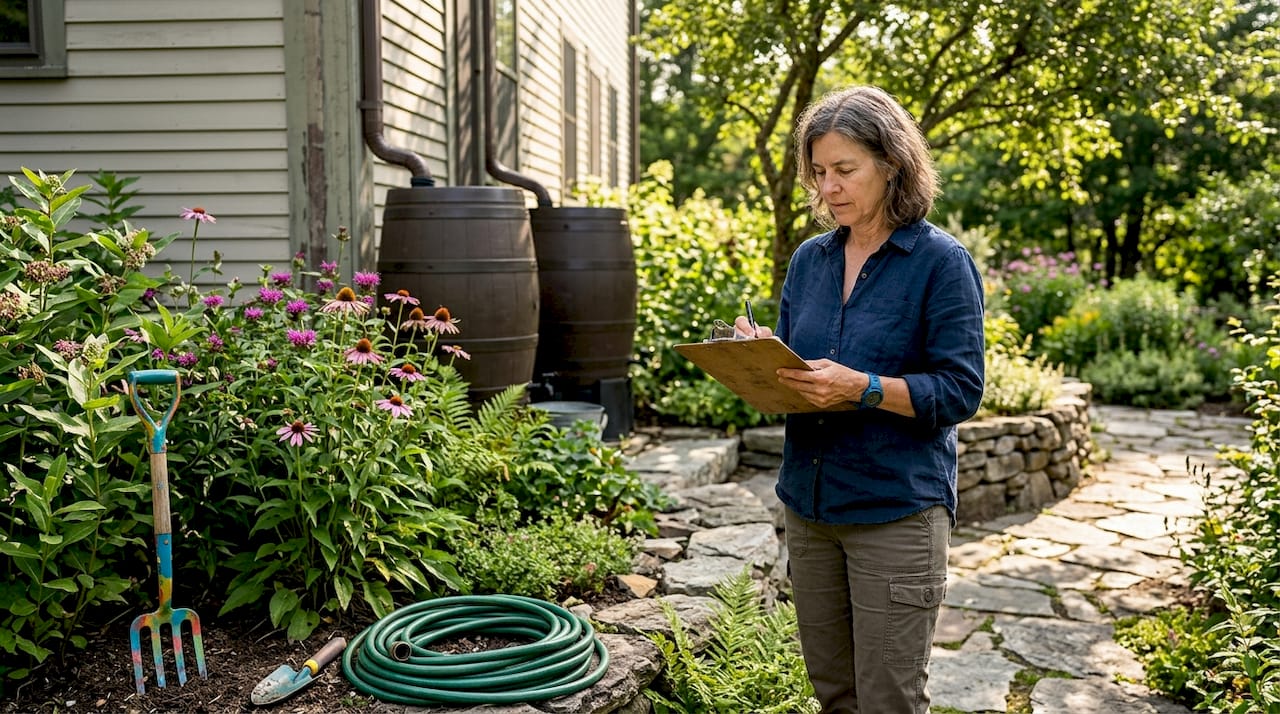
LEED landscaping is defined as the set of sustainable outdoor design and site management practices evaluated within the LEED green building rating system, specifically under the Sustainable Sites and Location and Transportation credit categories. Developed by the U.S. Green Building Council, LEED does not offer a standalone landscaping certification. Instead, it scores landscaping decisions as part of a broader building project certification. For New Hampshire homeowners and landscapers, understanding these standards opens the door to outdoor spaces that work harder, cost less to maintain, and hold up better through New England’s demanding seasonal shifts.
What criteria does LEED use to evaluate landscaping?
LEED v5 allocates up to 18 points in Location and Transportation credits and addresses landscaping directly through the Sustainable Sites category. That point allocation signals how seriously the rating system treats site decisions, not just building materials or energy systems.
The Sustainable Sites category covers six credits that work together to treat the land itself as a sustainability solution. Each credit targets a specific environmental challenge.
- Site assessment: Evaluate soils, drainage, vegetation, wildlife habitat, and sun exposure before design begins.
- Habitat protection and restoration: Preserve existing ecosystems and restore degraded areas with native species.
- Open space: Maintain or create vegetated areas that support biodiversity and human access to nature.
- Rainwater management: Reduce runoff volume and improve water quality through green infrastructure.
- Heat island reduction: Use shade trees and reflective or permeable materials to lower surface temperatures.
- Light pollution reduction: Minimize artificial light that disrupts nocturnal wildlife and neighboring properties.
Location and Transportation credits focus on where a project sits relative to transit, existing development density, and bicycle infrastructure. These credits reward site selection that reduces car dependence and preserves undeveloped land.
| LEED Credit | Primary Goal | Landscaping Technique |
|---|---|---|
| Site Assessment | Baseline environmental data | Soil, drainage, and habitat mapping |
| Habitat Restoration | Biodiversity recovery | Native plant installation |
| Rainwater Management | Runoff reduction | Bioswales, rain gardens, permeable paving |
| Heat Island Reduction | Surface cooling | Shade trees, reflective hardscape |
| Open Space | Ecosystem connectivity | Vegetated buffers and pollinator corridors |
| Location and Transportation | Reduced land consumption | Infill site selection, transit proximity |
Pro Tip: Start your site assessment before you finalize any planting plan. LEED rewards early evaluation of soils, drainage, and existing vegetation because those findings shape every design decision that follows.
How does LEED landscaping benefit New Hampshire homeowners?
Native plants reduce water requirements, fertilizer needs, and mowing frequency while filtering runoff, stabilizing soil, storing carbon, and supporting pollinators. For a New Hampshire yard, that translates directly to lower water bills and fewer hours behind a mower each season.

The financial case for sustainable landscaping extends well beyond utility savings. Proactive rainwater and soil management can reduce climate-related property damage costs over a 50-year period. New Hampshire properties face freeze-thaw cycles, spring flooding, and summer heat events, all of which erode conventional landscaping faster than native, well-designed plantings.
Eco-conscious buyers increasingly factor outdoor sustainability into purchase decisions. A yard designed around professional landscape design principles that align with LEED criteria signals lower long-term maintenance costs to prospective buyers. That perception adds measurable marketability.
The ecosystem benefits compound over time. Stormwater mitigation reduces the risk of basement flooding and soil erosion on sloped New Hampshire lots. Heat island reduction from strategic tree planting lowers cooling loads in summer. Pollinator habitat supports local agriculture and garden productivity. These are not abstract environmental goals. They are practical outcomes you can see and measure on your own property.
How can you apply LEED landscaping principles at home?
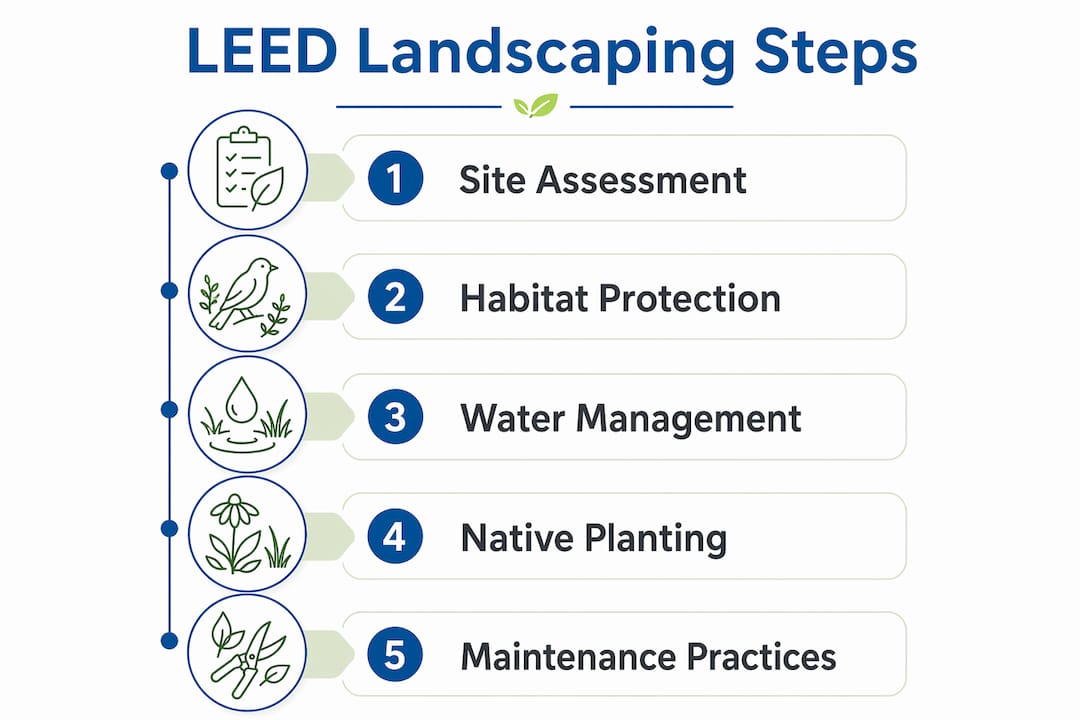
Applying LEED-aligned green landscaping principles follows a clear sequence. Each step builds on the one before it.
-
Conduct a full site assessment. Map your soil type, drainage patterns, existing vegetation, sun exposure, and any wildlife corridors on or near your property. Early site evaluation produces better design outcomes and avoids costly corrections later.
-
Choose native plants for your region. New Hampshire natives like wild columbine, buttonbush, and inkberry require far less irrigation and fertilizer than ornamental imports. They also establish faster because they evolved in local soil and climate conditions.
-
Install green infrastructure for stormwater. Bioswales, rain gardens, and permeable paving intercept runoff before it leaves your property. A rain garden planted with native sedges and rushes can absorb significant volumes of stormwater from a single storm event.
-
Manage the heat island effect with strategic planting. Shade trees cool surfaces and neighborhoods by reducing the amount of solar energy absorbed by pavement and rooftops. Deciduous trees on the south and west sides of your home provide summer shade and allow winter sun through after leaf drop.
-
Use reflective or permeable hardscape materials. Light-colored pavers and permeable concrete reduce surface temperatures compared to standard asphalt. They also allow rainwater to infiltrate rather than sheet off into storm drains.
-
Reduce or eliminate turf grass. Conventional lawn requires more water, fertilizer, and mowing than almost any other landscape element. Replacing turf with native groundcovers or mixed plantings cuts maintenance time and supports soil health.
Pro Tip: Design one feature to serve multiple functions. A stormwater pond can double as a shaded gathering space and pollinator habitat, stacking environmental and social benefits into a single investment.
For a deeper look at how these principles translate into a full property plan, the landscape design guide for NH homeowners covers the design process from initial concept through installation.
Is LEED the right certification for a landscaping project?
LEED does not offer a separate landscaping certification. Landscaping credits are integrated into LEED’s Building Design and Construction and Interior Design and Construction rating systems. That means LEED landscaping credits only apply when a building project is also seeking LEED certification.
For projects that involve land only, such as a park, campus grounds, or a residential yard without a new building, the Sustainable SITES Initiative (SITES) is the more appropriate framework. SITES prioritizes ecosystem health, stormwater management, human wellbeing, and climate resilience as standalone goals. It was designed specifically for landscape projects where no building certification is involved.
| Factor | LEED | SITES |
|---|---|---|
| Scope | Building projects with site components | Land-only or landscape-focused projects |
| Landscaping role | Credit category within broader certification | Primary certification focus |
| Best use | New construction or major renovation | Parks, campuses, residential grounds |
| Administering body | U.S. Green Building Council | Green Business Certification Inc. |
For most New Hampshire homeowners improving an existing yard, SITES principles offer a more direct framework. For commercial developers or property managers building new structures, LEED’s Sustainable Sites credits apply directly. Either way, the underlying ecological landscaping techniques, native plants, green infrastructure, and habitat restoration, are the same.
Understanding how landscaping affects property value in New Hampshire helps you decide which framework fits your project goals and budget.
Key Takeaways
LEED landscaping delivers the greatest value when treated as active site infrastructure rather than decoration, combining native plants, green infrastructure, and habitat design into a system that manages water, temperature, and biodiversity simultaneously.
| Point | Details |
|---|---|
| LEED evaluates, not certifies, landscaping | Landscaping earns points within LEED building certifications, not as a standalone credential. |
| Six Sustainable Sites credits cover landscaping | Credits address habitat, rainwater, heat island, open space, light pollution, and site assessment. |
| Native plants cut maintenance costs | New Hampshire natives reduce irrigation, fertilizer, and mowing needs while supporting local ecosystems. |
| SITES suits land-only projects | Projects without buildings should pursue SITES certification instead of LEED. |
| Stacking functions maximizes return | One feature serving multiple purposes, such as a rain garden that is also a gathering space, delivers the best ecological and financial outcomes. |
Landscapes as infrastructure: a perspective worth adopting
Most homeowners think of their yard as something to look at. I’ve found that the moment you start thinking of it as something that works, everything changes.
A well-designed yard in New Hampshire manages water during a spring thaw, cools your home during a July heat wave, and supports the pollinators that keep your garden productive. None of that happens by accident. It happens because someone made deliberate decisions about plant selection, grading, drainage, and materials before a single shovel hit the ground.
The biggest mistake I see is treating landscaping as the last item on a construction budget, the thing you do after the “real” decisions are made. Landscapes functioning as infrastructure deliver environmental, social, and financial benefits that decorative plantings simply cannot. A row of ornamental shrubs looks nice. A bioswale planted with native rushes looks nice and keeps your basement dry.
New Hampshire’s climate makes this especially urgent. Freeze-thaw cycles destroy conventional hardscape. Spring flooding overwhelms standard drainage. Summer heat events stress non-native plantings into decline. The properties that hold up best are the ones where the outdoor design was treated as seriously as the indoor design. LEED and SITES both push designers toward that mindset. You do not need a certification to adopt it.
— Damian
Sustainable landscaping services from Divinelandscapingllc
Divinelandscapingllc works with New Hampshire homeowners and property managers to design outdoor spaces that meet real sustainability goals, not just aesthetic ones. The team specializes in native plant selection, stormwater management solutions like rain gardens and bioswales, and green infrastructure installation suited to New England’s climate and soil conditions.
Whether you are planning a residential yard redesign or managing a multi-tenant property landscaping project with sustainability requirements, Divinelandscapingllc brings the design expertise to align your outdoor space with LEED-aligned principles. Contact the team to schedule a consultation and get a plan built around your property’s specific site conditions.
FAQ
What is LEED landscaping in simple terms?
LEED landscaping refers to sustainable outdoor design practices, such as native planting, rainwater management, and heat island reduction, that earn points within the LEED green building rating system’s Sustainable Sites and Location and Transportation credit categories.
Does LEED offer a standalone landscaping certification?
No. LEED evaluates landscaping as part of building project certifications like LEED BD+C. Projects focused solely on land improvement typically pursue SITES certification instead.
What are the main LEED credits related to landscaping?
The Sustainable Sites category includes six credits covering site assessment, habitat protection and restoration, open space, rainwater management, heat island reduction, and light pollution reduction.
How do native plants support LEED landscaping goals?
Native plants reduce irrigation demand, eliminate the need for synthetic fertilizers, and require less mowing. They also filter runoff, stabilize soil, store carbon, and provide pollinator habitat, all of which align with LEED Sustainable Sites criteria.
Is LEED landscaping worth pursuing for a New Hampshire homeowner?
Yes, even without formal certification. Applying LEED-aligned practices, such as native planting, permeable paving, and stormwater design, reduces long-term maintenance costs, improves property resilience against New Hampshire’s seasonal extremes, and increases marketability to eco-conscious buyers.