
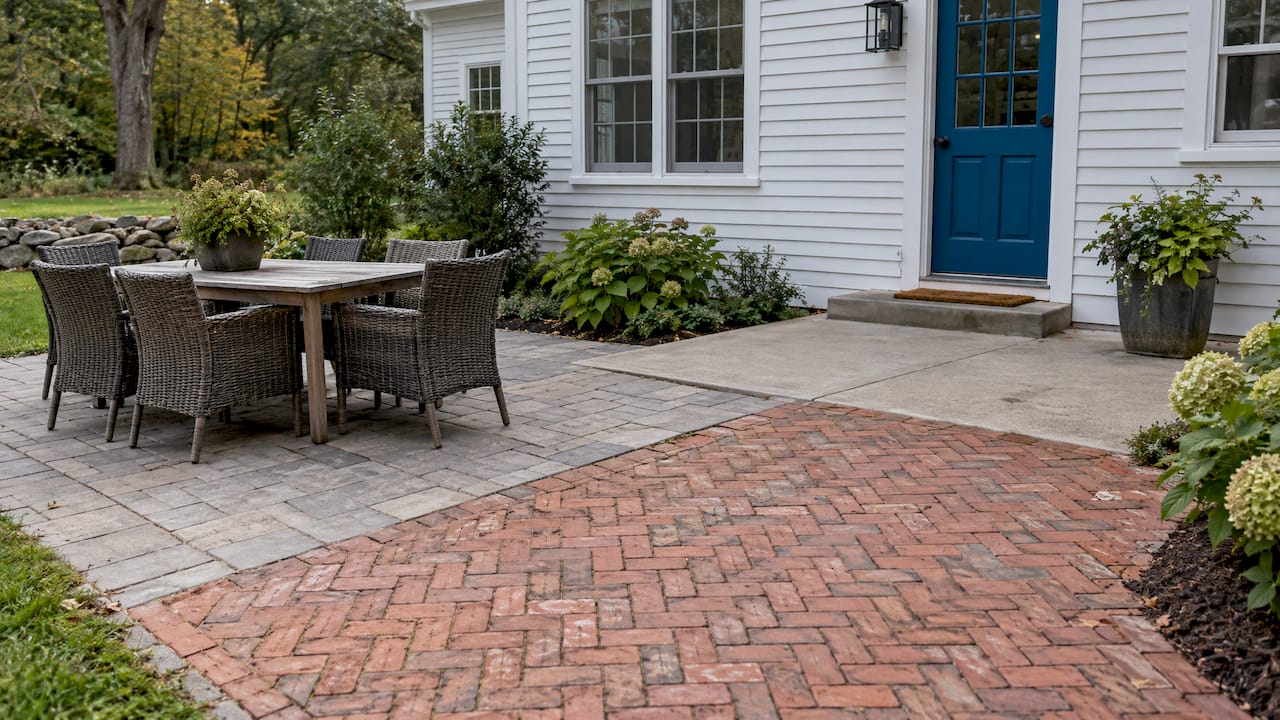
For most New Hampshire yards, the real choice is between clay brick pavers, concrete pavers and a poured concrete slab. Concrete pavers usually cost the least of the paver options and come in the widest range of shapes. Brick pavers cost more and offer a classic look and a very long track record. A poured slab is one rigid surface that can crack as frost moves the ground. Which one fits depends on your budget, the look you want and, above all, how well the base under it is built. Our crews design and install patios, walkways and retaining walls across New Hampshire and neighboring Massachusetts, and the base and drainage decide the result more than the surface material does.
TL;DR
- Cost: brick pavers average 15 to 20 percent more than concrete pavers.
- Design range: concrete pavers come in many colors, textures and shapes. Brick comes in fewer sizes and mostly rectangles and squares.
- Winter performance: pavers of either kind are a semi-flexible system that tolerates minor ground movement. A cracked rigid slab does not.
- Repairs: both brick and concrete pavers can be lifted and replaced one unit at a time.
- The deciding factor: a compacted base, proper slope and edge restraints matter more than the material you pick.
Table of Contents
- Three materials people mean by “brick vs. concrete”
- Side-by-side comparison
- Cost: what you pay for and why
- Appearance and design options
- Durability in New Hampshire winters
- Repairs and maintenance
- The base matters more than the surface
- Which one fits which property
- Our perspective
- Plan your patio with Divine Landscaping
- FAQ
- Sources
Three materials people mean by “brick vs. concrete”
The phrase covers more than two products, so it helps to separate them.
Clay brick pavers are fired clay units made for walking and driving surfaces. They are the traditional choice, with a warm, natural color that comes from the clay itself.
Concrete pavers are factory-made units. According to the Concrete Masonry & Hardscapes Association (CMHA), they begin curing in a climate-controlled factory and are made with two to three times the strength of typical poured concrete. CMHA is the trade association for the concrete paver industry.
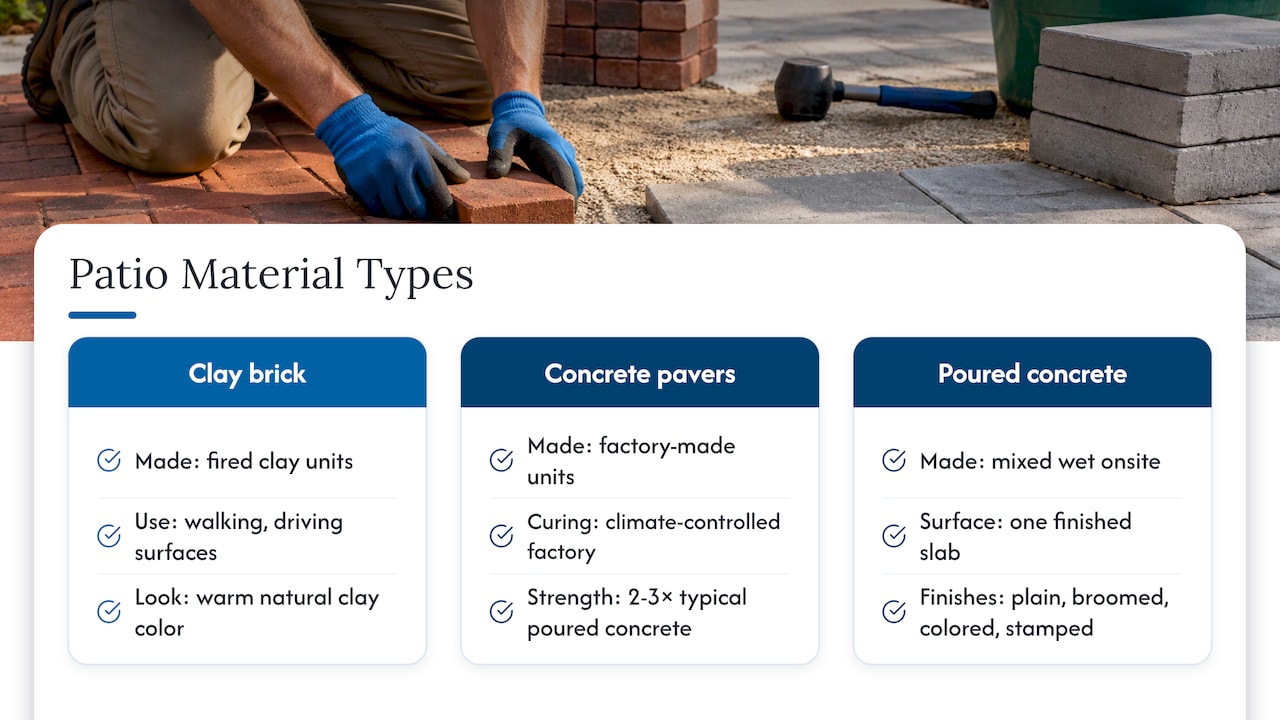
Poured concrete is mixed and placed wet on your property, then finished as a single slab. It can be left plain, broomed, colored or stamped with a pattern.
When people search “brick vs. concrete patio,” they are often comparing a paver patio (brick or concrete) with a poured slab. We cover both comparisons below.
Side-by-side comparison
| Factor | Brick pavers | Concrete pavers | Poured concrete slab |
|---|---|---|---|
| Typical cost | Highest of the three paver and slab options in most comparisons | About 15 to 20 percent below brick | Varies with finish and thickness |
| Look | Classic, natural clay color | Wide range of colors, textures, shapes | Plain, broomed or stamped |
| Shape and size options | Few sizes, mostly rectangles and squares | Wide array | Any outline, formed on site |
| Frost movement | Joints and base flex | Joints and base flex | Rigid, can crack |
| Repairs | Replace individual units | Replace individual units | Patch or replace sections |
| Upkeep | Joint sand, weeds, occasional cleaning | Joint sand, weeds, occasional cleaning | Sealing, crack repair |
The cost gap between brick and concrete pavers comes from This Old House’s guide to brick pavers. Your own price depends on patio size, access, soil, and whether an old patio has to be removed first.
Cost: what you pay for and why
Brick pavers average 15 to 20 percent more than concrete pavers, and the difference shows up in the materials. Labor can add to it as well. Brick units vary slightly in dimension, so crews spend more time cutting, aligning and adjusting. That is one reason we recommend comparing quotes on the full scope of work, not on the material line alone.
When you collect quotes for any patio, compare these items:
- Excavation and base depth. How deep will the crew dig, and how much compacted stone goes in?
- Edge restraints. Are they included? CMHA says edge restraints are essential to resisting movement, minimizing sand loss and preventing paver rotation.
- Drainage plan. Where does water go, and what slope is built in?
- Removal of an old patio, if there is one.
- Cutting and layout. Curves and patterns add labor.
- Joint sand and finishing.
A low quote that skips base depth or edge restraints is not really lower. It leaves out the work that keeps the patio flat.
Appearance and design options
Brick has a look that does not date: warm reds, browns and charcoals, often laid in herringbone or basket weave patterns beside older New England homes. If your house is a colonial, a Cape or a brick-faced building, a brick patio can look like it has always been there.
Concrete pavers give you more to choose from. Concrete pavers come in a wide array of colors, textures and geometric shapes, while brick comes in only a few sizes and mostly rectangles and squares. That matters if you want curves, a circular firepit area, a modern large-format look or a stone-like texture. Many homeowners choose concrete pavers for a backyard entertaining space and brick for a front walkway or entry.
Poured concrete is the plainest option. Stamping and coloring can imitate stone or brick, but the surface is one continuous sheet, so any crack is visible.
If you are also weighing natural stone, our guide to pavers vs. flagstone for a New Hampshire yard covers that comparison. For a broader view of options, see the best patio materials in NH.
Durability in New Hampshire winters
New Hampshire patios go through repeated freezing and thawing. Water gets into the soil under a patio, freezes, expands and pushes upward. When it thaws, the ground settles unevenly. The surface you choose has to cope with that movement.
Pavers move with the ground. CMHA’s Robert Bowers describes concrete pavers as a semi-flexible pavement system that stays structurally sound through minor settling. A rigid poured slab that cracks deteriorates structurally.
Brick lasts a very long time. This Old House reports the brick industry’s conservative lifespan estimate at 40 years, and notes that brick-paver sidewalks in colonial-era cities have served nearly 150 years. That is the kind of history you want when you plan to keep a house for decades.
Most winter damage traces back to construction. CMHA’s maintenance guide says performance problems can come from inadequate design, inappropriate materials, ineffective construction techniques or missing maintenance. Choosing between brick and concrete pavers matters less than getting the base, slope and edges right. Our checklist on preventing freeze-thaw paver damage walks through what to look for.
Timing matters too. CMHA’s guide specification says not to install sand or pavers over frozen base materials. In New Hampshire, that makes the construction season and the schedule part of a durable result, so plan your project well ahead of winter.
Repairs and maintenance
One advantage of paver patios is that they are modular. If a unit stains, chips or sinks, a crew can lift it and put in a replacement without disturbing the surrounding area. That holds for both brick and concrete pavers. A poured slab has to be patched or have sections cut out, and the repair is usually visible.
Expect some routine upkeep with any paver patio:
- Joint sand. Sand between the units can wash out. CMHA recommends routine preventive maintenance, including refilling joints.
- Weeds. Sand-filled joints can grow weeds, a known annoyance with brick pavers in particular.
- Efflorescence. A white haze can appear on pavers some time after installation. CMHA explains that it is cosmetic, not structural, and it does not mean the color is fading.
- Snow removal. Use plastic or rubber-edged tools where you can, and take care around edges.
The base matters more than the surface
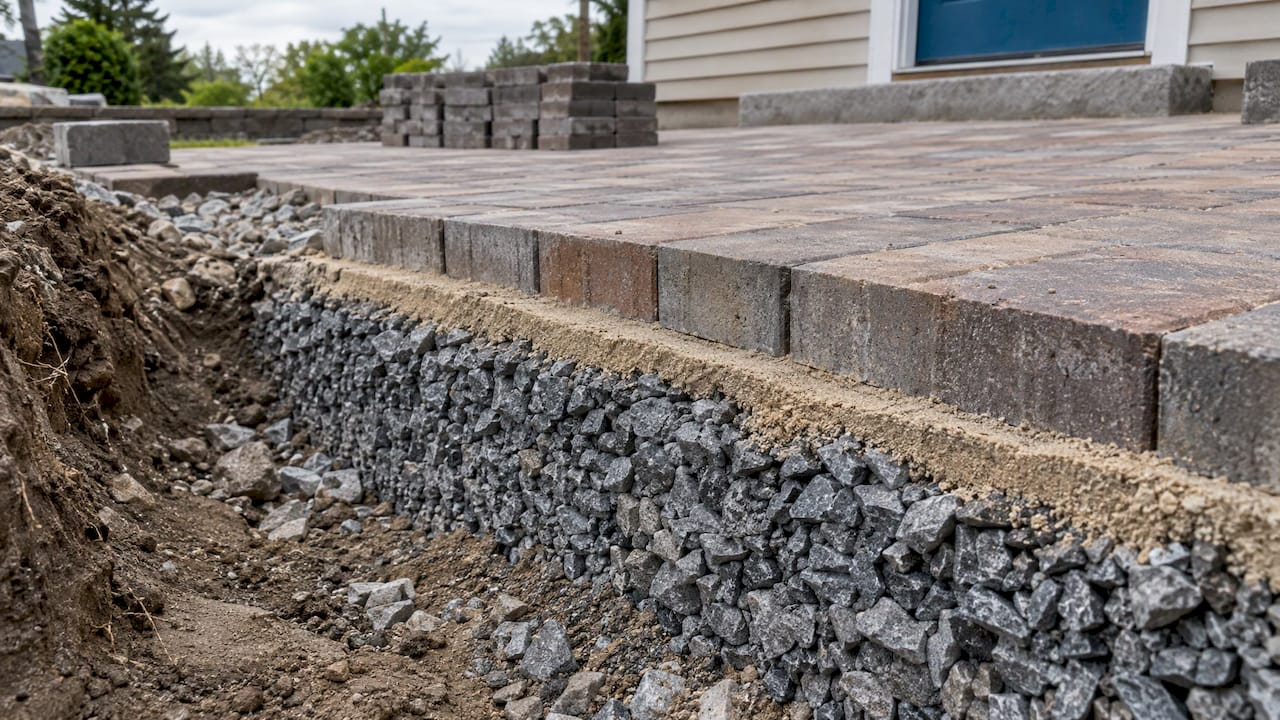
Pavers cannot be laid straight on dirt. A paver patio needs excavation, a compacted aggregate base (crushed stone), a leveling layer of sand, edge restraints and jointing sand. The base is what carries the load and handles frost movement. Skipping depth to save money is the most common cause of sunken, wavy patios. Our article What Is a Patio Base, and Do You Actually Need One? explains each layer.
Drainage is the other half. A patio should slope slightly away from the house so water runs off instead of pooling against the foundation. For a deeper look at how slope and runoff work in outdoor living design, see this guide to outdoor living design. If you already have standing water on a patio, our patio drainage fixes cover three options. On a sloped lot, see how to build a patio on a slope.
Which one fits which property
Choose brick pavers if:
- Your house has traditional or colonial character that brick suits.
- You value a long track record and a classic, natural color.
- You are building a walkway, entry or smaller patio where a higher material cost is spread over fewer square feet.
Choose concrete pavers if:
- You want the widest choice of colors, textures and shapes.
- You want curves, borders, a firepit circle or a modern look.
- You are paving a larger backyard and want the best price per square foot among paver options.
Consider a poured slab if:
- You want a simple, flat surface and the ground is stable and well drained.
- You accept that a cracked slab is repaired by patching, not by swapping one unit.
For commercial properties: entrances, courtyards and walkways take foot traffic every day. A modular surface lets a property manager repair one damaged area quickly without closing a whole section. Our multi-tenant property landscaping guide covers planning for shared sites.
For front walkways specifically, see contractor-vetted walkway materials. If you want a surface that lets water pass through, read about permeable paver patios.
Our perspective
When homeowners ask us about brick versus concrete, we ask about the yard first. How does water move across it? What is the soil like? Where does snow pile up? Where do you want to sit?
We design every patio around the property, and that is why we start with a consultation and a clear plan from the first visit to installation. Material choice follows from that. Brick suits some houses beautifully. Concrete pavers give others the shapes and colors they want at a lower cost per square foot. Both work in New Hampshire when the base is compacted, the edges are restrained and the slope sends water away from the house.
We build with premium materials and stand behind our work with a satisfaction guarantee. Our team brings more than 20 years of combined hands-on experience to patios, walkways and retaining walls. We would rather talk through your goals on site and agree on the right scope than hand you a catalog.
Damian
Plan your patio with Divine Landscaping
If you are ready to choose between brick, concrete pavers or another surface, our patio installation services cover design and construction for homes and commercial properties in New Hampshire and Massachusetts. We also build walkways, retaining walls, firepits and outdoor kitchens through our masonry and hardscape work, so the whole outdoor space can be planned together. Start with a conversation about your yard and your budget, and we will walk you through the options on site.

If you are in Salem or Windham, see our local pages for patio installation in Salem, NH and patio installation in Windham, NH.
FAQ
What are the downsides of using pavers?
Brick pavers cost 15 to 20 percent more than concrete pavers, come in fewer sizes and shapes, and can grow weeds in sand-filled joints. Joint sand needs topping up from time to time. A well-built base and good joint maintenance keep these points manageable.
How long do clay brick pavers last?
The brick industry’s conservative estimate is 40 years, and brick-paver sidewalks in colonial-era cities have lasted nearly 150 years. Actual life depends on how well the base was built and how the patio is maintained.
Are bricks and pavers the same?
No. “Pavers” is the broader term for units made for walking and driving surfaces. They can be clay brick or factory-made concrete. Clay brick pavers are fired clay, while concrete pavers are manufactured from concrete in a controlled factory setting.
Can I just lay pavers on dirt?
No. Pavers need a prepared, compacted base of crushed stone with a leveling layer of sand, plus edge restraints. Without a base they settle and shift, especially through freeze-thaw cycles. Our guide to the patio base explains the layers.
Is a paver patio better than poured concrete in New Hampshire?
For many yards, yes, because pavers work as a semi-flexible system that handles minor ground movement and lets you replace individual units. A poured slab can suit a stable, well-drained spot where a plain surface is the goal.
Sources
- Pavers vs. Concrete: Myths, Facts, and What Homeowners Need to Know (CMHA)
- Operation and Maintenance Guide for Interlocking Concrete Pavements (CMHA)
- Pavers on Aggregate Base guide specification (CMHA)
- All About Brick Pavers: Pros & Cons, Types, Installation (This Old House)